2025’s wave of artificial intelligence adoption is creating several new innovations for Learning Management Systems. Several of these platforms are shifting from “course delivery and tracking” to “learning guidance and performance support.” These new systems are responding to and interpreting learner behavior in real time, rather than simply hosting content and reporting completion and analytics data.
Here are some summaries of innovations impacting Learning Management Systems and Learning Experience Platforms in 2026:
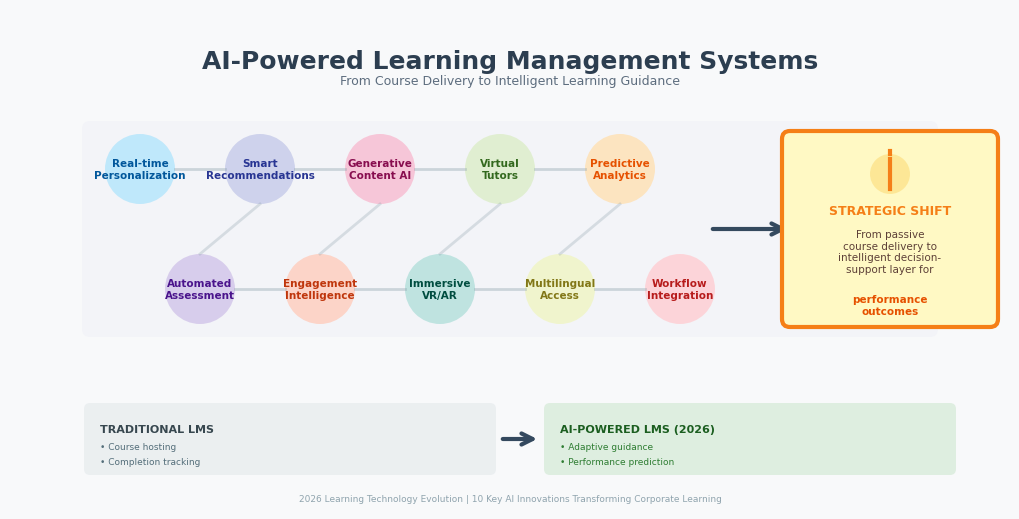
- Real-time personalization (adaptive learning paths): LMS platforms are increasingly able to adjust their pacing, levels of difficulty, and content sequencing based on a learner’s behavior, not just their completion metrics or their test metrics.
- Recommendation engines for “next-best learning”: Instead of asking learners to browse catalogs, AI is taking a more pro-active approach by recommending relevant content based on role, progress, and interaction history, similar to how consumer platforms curate suggestions.
- Generative AI embedded in the LMS for faster content cycles: New versions of LMS systems are incorporating tools that accelerate the creation and updating of quizzes, assessments, scenarios, and summaries. This assistive technology helps instructors and course development staff create more effective content in less time.
- Always-on virtual tutors and natural-language interfaces: Learners can get guidance and answers inside the LMS through conversational assistants (much like chatbots) that reduce tension and improve completion rates. This innovation is especially valuable in self-paced learning or for complex topics.
- Predictive analytics (from reporting to early warning and forecasting): LMSs are moving beyond the old model of simply tracking learner behavior to acting on that data by predicting which learners are at risk, where their skill gaps are, and where intervention is likely to help with learning transfer.
- Automated assessment and faster feedback loops: In previous systems, instructional designers had to write feedback text themselves. Newer systems are learning to be responsive, with automated grading and feedback customized for each learner based on their prior responses.
- Behavioral and engagement intelligence (beyond completions): Viewing completion matrices are nice for getting an idea of who has or has knot completed their assigned coursework, but 2026-era LMS innovations focus on more granular signals, including time-on-task and interaction patterns. This helps to understand learner engagement and pinpoint where learning design is breaking down.
- Immersive learning (VR/AR) moving toward mainstream adoption: VR/AR is increasingly treated as a standard modality for high-stakes practice and skill rehearsal/practice, with directly connected LMSs serving as the system of record and insight layer around that practice.
- Accessibility and multilingual support at scale: AI-driven translation and speech capabilities are positioned as part of making learning more inclusive, more scalable, and more consistent across diverse populations.
- Connected learning ecosystems and workflow integration: In 2026, LMS platforms are expected to integrate more tightly with content creation and course production tools as well as broader talent development systems, so learning is triggered by real needs and tied more directly to outcomes.
What this means for institutional leaders (the strategic takeaway)
The takeaway is not just that Learning Management System vendors have added AI features that keep pace with the recent “boom” of AI technologies. The real headline is that Learning Management Systems are becoming a decision-support layer for learning. This intelligence layer can personalize experiences, anticipate risk, and connect learning activity to readiness and performance outcomes.