AI Tools
Higher Education
Learning & Development

Across the global education landscape, administrators and educators are staring at the same horizon. The arrival of generative AI has created a unique tension: an urgent pressure to adopt new technologies balanced against a profound lack of a clear roadmap. As we move forward with the AI innovations available for 2026, school leaders may feel overwhelmed, wondering if "readiness" simply means buying a few licenses for a chatbot or if it requires something more fundamental.
The reality is that the rush to integrate AI often outpaces the institutional capacity to manage it. Without a structured approach, schools risk fragmented implementation that fails to protect students or empower teachers. This post distills the most impactful takeaways from cutting-edge global frameworks and expert assessments—looking ahead at the standards being set for the next two years—to help clarify what it actually means to be truly AI ready.
The reality is that the rush to integrate AI often outpaces the institutional capacity to manage it.
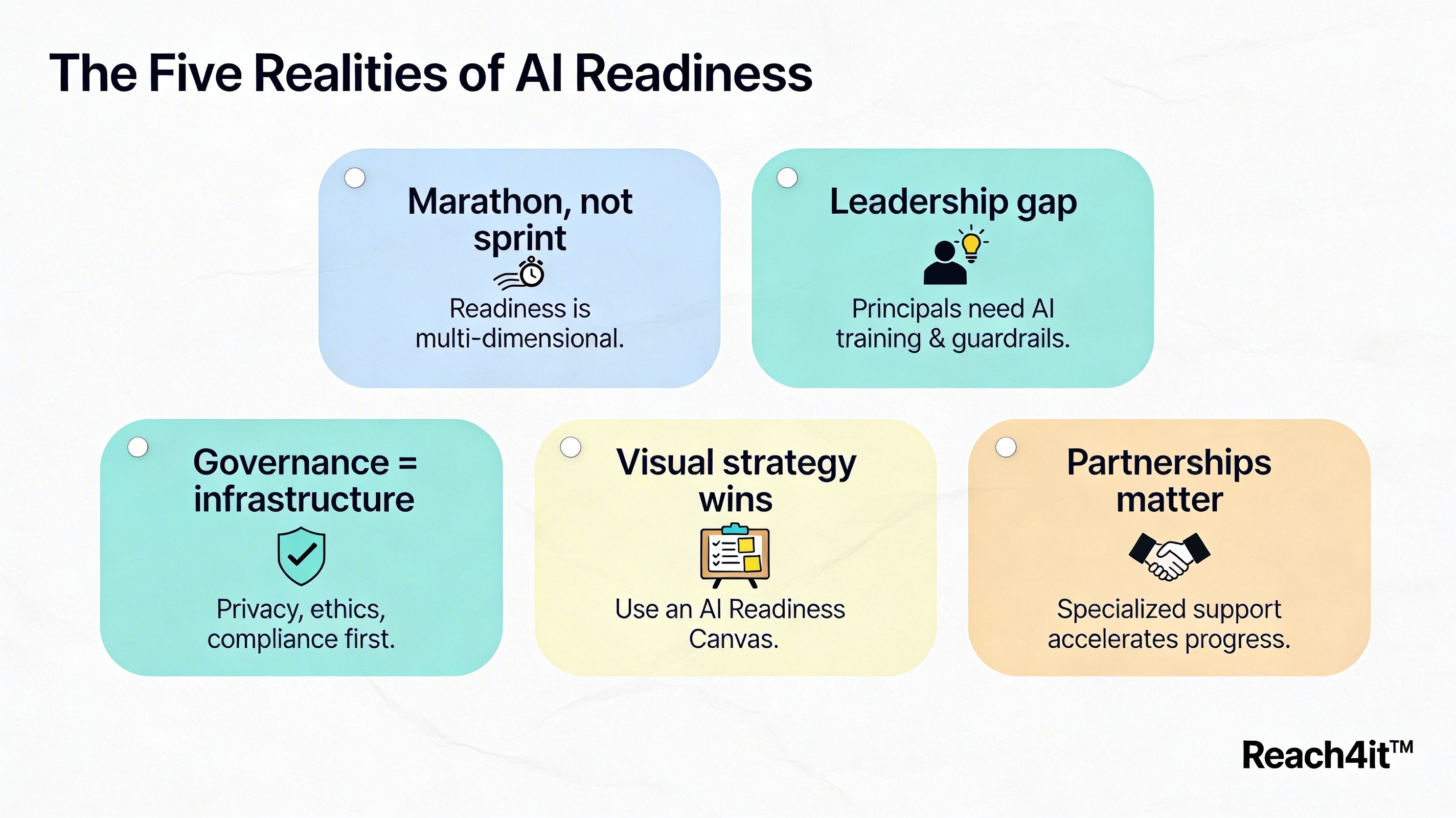
For years, technological readiness in schools was measured by bandwidth and hardware. However, as highlighted by the Digital Education Council’s February 2026 framework and eCampus News, AI readiness has evolved into a holistic, multi-dimensional challenge. The Ten Dimension AI Readiness Framework suggests that schools must evaluate themselves across ten distinct areas rather than checking a single technical box.
This 10-dimension view is far more realistic than a simple "yes/no" checklist. It acknowledges that an institution might be technically capable but ethically unprepared, or pedagogically ambitious but legally vulnerable. By treating readiness like a decathlon, schools can identify specific weaknesses—such as data privacy or faculty training—without stalling their entire AI strategy. The bottom line is simple: if you only focus on the tech, you ignore nine other ways to fail.
"AI readiness is not a software update; it is an institutional ecosystem where pedagogy, ethics, and infrastructure must move in lockstep to prevent systemic failure."
A critical insight from Educational Innovation 360* is that the success of AI integration depends heavily on school leadership. While much of the conversation focuses on student use, there is a significant "readiness gap" among K-12 principals. For AI to succeed in the classroom, principals require specific training, clear guidance, and established guardrails.
If a principal is not "AI ready," the classroom cannot be. Leadership readiness impacts the entire institution; without an informed principal, teachers lack the support and psychological safety needed to experiment with AI tools. Leaders don't just need general exposure to AI—they need the professional development to manage the cultural and operational shifts that AI brings to their specific school environments. When AI adoption strategy is treated as an "IT issue" rather than a "leadership issue" the natural reaction is to create an immediate ceiling for institutional growth.
One of the most significant shifts in the current landscape is the move toward formal auditing. Readiness now includes legal and ethical governance, treating AI as a compliance and safety issue rather than just a pedagogical one. Organizations like RAISE-Labs have introduced the K-12 AI Governance Readiness Audit, while the Digital Education Council offers institutional assessment tools to formalize this process.
The Strategic Power of Guardrails It might seem counter-intuitive, but strict "guardrails" and governance audits actually accelerate innovation. When a school establishes clear rules regarding data privacy and ethical use, it creates a safe environment for teachers to experiment. Without these audits, fear of misuse or legal repercussions often leads to "shadow AI" use or total avoidance, both of which hinder institutional progress. In the modern era, governance is the new infrastructure; it provides the foundation upon which all learning is built.
When a school establishes clear rules regarding data privacy and ethical use, it creates a safe environment for teachers to experiment.
As schools move away from static, lengthy policy documents that are outdated before they are even printed, a new trend has emerged: the use of visual strategy tools. Sources such as Miro, Incremental Excellence, and AI Transformation Readiness all point to the AI Readiness Canvas as a superior way to map out institutional change.
Using a collaborative, visual template allows stakeholders from IT, curriculum, and administration to achieve cross-functional alignment by seeing the entire strategy on a single page. These canvases provide the agility necessary to update plans as AI technology evolves rapidly, far exceeding the flexibility of a formal policy document. Furthermore, they offer strategic clarity by breaking down complex transformations into manageable blocks, such as value propositions and resource allocation. A visual canvas turns a dense policy into a living roadmap that survives first contact with the classroom.
Institutions are increasingly realizing they do not have to navigate this transition alone. We are seeing a surge in specialized AI Education Consultants and high-level institutional partnerships designed to bridge the expertise gap. For example, EDUCAUSE launched a generative AI readiness assessment tool for higher education in collaboration with Amazon Web Services (AWS), signaling that even the largest institutions require external validation.
This trend toward specialized expertise is becoming a standard part of the readiness process. Firms like BridgeView IT* and UMU** are no longer just vendors; they are essential partners that help institutions transform learning by auditing systems and improving training protocols. Leveraging external consultants allows schools to access a depth of knowledge that internal IT departments are often not yet built to provide. Scaling AI transformation requires a depth of expertise that most internal teams are still struggling to develop.
AI readiness is not a destination but a continuous state of institutional evolution. The frameworks and tools emerging today—from 10-dimension assessments to visual canvases—all point toward a single truth: technology is only one piece of the puzzle. The most successful schools will be those that prioritize leadership training, formal governance, and collaborative planning.
As you look at your own roadmap for the coming years, consider this: Is your institution measuring its AI readiness by the tools it buys, or by the strength of its human and ethical framework? The answer to that question will likely determine your success in the age of AI.
* BridgeView IT is a Denver-based, award-winning IT consulting and staffing firm founded in 2005 with over 20 years of experience. It specializes in connecting businesses with high-level IT talent—including developers and project managers—and provides strategic consulting, boasting a 100% on-time delivery rate for initiatives. They serve industries like finance, healthcare, and aerospace.
** UMU is an AI-powered, mobile-first learning and performance platform designed for corporate training, sales enablement, and employee onboarding. It focuses on enhancing productivity by blending micro-learning, interactive tools, and data analytics to drive skill retention. UMU helps businesses create engaging content, such as videos and practice simulations, to improve workforce competency.
Bibliography
Digital Education Council. “Ten Dimension AI Readiness Framework.” Digital Education Council, February 5, 2026. https://www.digitaleducationcouncil.com/post/ten-dimension-ai-readiness-framework.
“10 Dimensions of AI Readiness.” eCampus News, June 23, 2025. https://www.ecampusnews.com/ai-in-education/2025/06/24/10-dimensions-of-ai-readiness/.
aiEDU. “AI Readiness Framework.” The AI Education Project, June 13, 2024. https://www.aiedu.org/ai-readiness-framework-new.
“An Example AI Readiness in Education Assessment Framework.” Solutions Review, July 9, 2025. https://solutionsreview.com/an-example-ai-readiness-in-education-assessment-framework/.
Amazon Web Services. “EDUCAUSE Launches Generative AI Readiness Assessment Tool for Higher Education with AWS.” AWS Public Sector Blog, April 7, 2024.
https://aws.amazon.com/blogs/publicsector/educause-launches-generative-ai-readiness-assessment-tool-for-higher-education-with-aw/.
RAISE-Labs. “K-12 AI Governance Readiness Audit.” RAISE-Labs, December 31, 2024.
https://audit.raise-labs.org.
AI Capability Framework. “Institutional Assessment.” AI Capability, n.d.
https://www.aicapability.org/assessment.html.
Bellwether. “Building AI Readiness: Actionable K–12 Insights and Investment Priorities.” Bellwether, December 21, 2025. https://bellwether.org/publications/building-ai-readiness/.
Digital Education Council. “Higher Education Generative AI Readiness Assessment.” EDUCAUSE Library, 2024. https://library.educause.edu/resources/2024/4/higher-education-generative-ai-readiness-assessment.
Electives. “Know Your Audience: Why Assessing AI-Readiness Is Crucial Before Training.” Electives, October 8, 2025. https://www.electives.io/resources/ai-assessing-ai-readiness-is-crucial.
Educational Innovation 360. “Closing the AI Readiness Gap in K-12: Why Principals Need Training, Clear Guidance, and Guardrails.” Educational Innovation 360, November 28, 2025. https://www.educationalinnovation360.com/blogs/closing-the-ai-readiness-gap-in-k-12-why-principals-need-training-clear-guidance-.
BridgeView IT. “Transform Learning with AI Education Consultants in 2025.” BridgeView IT, April 23, 2025. https://www.bridgeviewit.com/blog/transform-learning-with-expert-ai-education-consultants/.
Higher Digital. “AI Readiness for Higher Education.” Higher Digital, July 12, 2025.
https://higher.digital/expertise/ai/.
UMU. “How Can AI Consultants Help Businesses Improve Their Training?” UMU, December 14, 2025. https://m.umu.com/ask/a11122301573854582616.
Educational Innovation 360. “Closing the AI Readiness Gap in K-12.” Educational Innovation 360, November 28, 2025. https://www.educationalinnovation360.com/blogs/closing-the-ai-readiness-gap-in-k-12-why-principals-need-training-clear-guidance-.
Sonix. “5 Best AI Tools for Higher Education Consultants in 2025.” Sonix, August 14, 2025. https://sonix.ai/ai/best-ai-for-higher-education-consultants/.
Alchemy Systems. “AI, Learning Science, and Human Expertise in Action.” YouTube video, May 21, 2025. https://www.youtube.com/watch?v=c4dWIjhxPyc.
TeachFX. “Developing Workflows and Partnering with AI to Increase Teacher Productivity.” YouTube video, September 24, 2024.
https://www.youtube.com/watch?v=LO2XtbR64Ao.
Miro. “AI Readiness Canvas Template.” Miroverse, n.d. https://miro.com/templates/ai-readiness-canvas/.
Incremental Excellence. “AI Readiness Canvas.” Incremental Excellence, September 17, 2025. https://www.incrementalexcellence.com/ai-readiness-canvas.
AI Transformation Readiness. “Canvas.” AI Transformation Readiness, May 9, 2023.
https://www.aitransformationreadiness.org/canvas.