For the past year, most conversations about AI in higher education have centered on students using tools like ChatGPT to complete assignments. Asides from this student-centered concern about how AI is impacting education, a much more important shift is happening quietly in terms of how teachers are creating their courses.
AI is rapidly changing how courses themselves are created.
This isn't merely a shift to course and assessment creation that saves time, it is rather a fundamental change in the workflow of instructional design, where AI tools now assist faculty in drafting learning objectives, structuring modules, mapping assessments, and organizing content — while instructors apply the judgment, pedagogy, and subject matter expertise that AI cannot replicate.
Whether higher education course creators realize it or not, these new capabilities are prompting the need for an institutional strategy change.
What the Research and Early Adopters Are Showing
Recent case studies and higher ed research (SpringerOpen, TechTrends, EDUCAUSE, Quality Matters) all point to the same pattern: When instructors use AI effectively in course creation, they don’t surrender the design of the course to the tool itsself.
They use AI to:
- Draft and refine learning objectives
- Generate initial course maps and module sequences
- Propose assessment alignment to objectives
- Suggest activities, examples, and explanations
- Analyze course content for gaps or redundancies
Then the instructor reviews, edits, refines, and aligns everything to pedagogy, standards, and disciplinary expertise. Using these tecniques, AI becomes a design partner, not a designer. And this is where institutions are starting to realize something important:
If faculty are going to work this way, the institution needs to plan for it.
The Tools Are Already Inside the Workflow
This shift isn’t theoretical. The tools are already embedded in platforms faculty use every day:
- Canvas (integrated with Kahn Academy's "Khanmigo") provides context-aware AI support inside the LMS for quizzes, rubrics, and content alignment
- Articulate 360 AI Assistant generates structured lesson drafts with its eLearning authoring tools
- LearnWorlds and other AI-enabled authoring platforms create outlines, activities, and assessments that instructors can customize
- Generative AI tools (Chat GPT, Claude, and Gemini, et al) are being used with backward design models to build courses from objectives outward
Faculty are experimenting with these tools whether institutions have a plan or not. Which raises the real question: Has your institution created a master plan for this new workflow?
Why This Is a Strategic Planning Issue for Leadership
Institutions that are ahead of this curve are not asking, “Should we allow AI?”
They are asking:
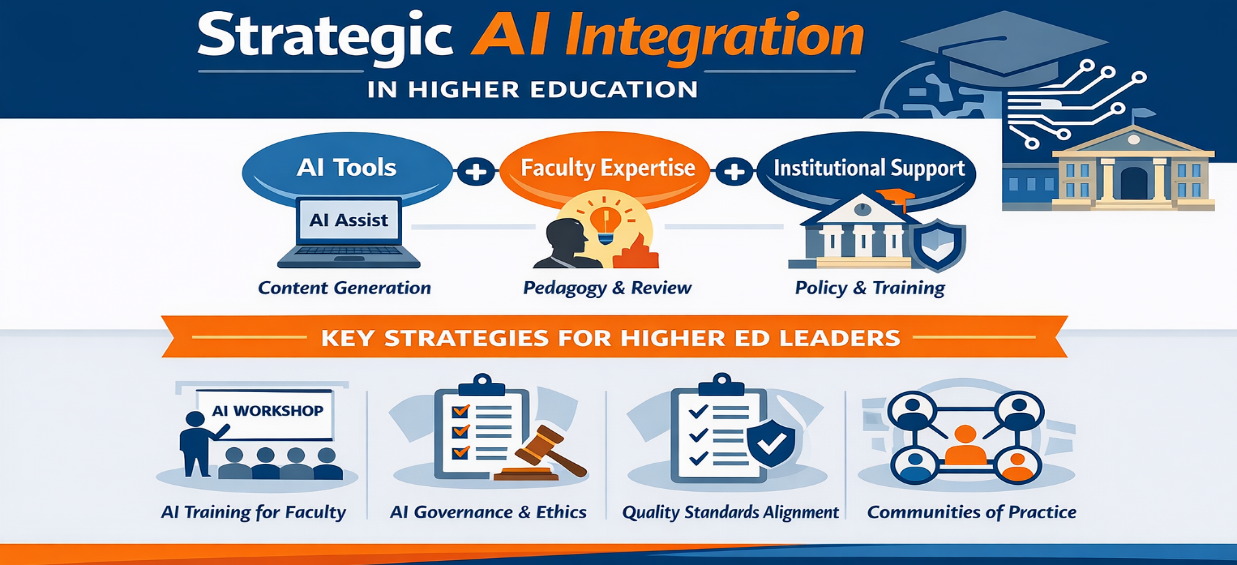
- How do we train faculty to use AI within sound instructional design principles?
- How do we align AI use with Quality Matters, accreditation, and learning standards?
- What policies and governance are needed to ensure ethical, consistent use?
- How do we build AI literacy into professional development?
- How do we create communities of practice where faculty share what’s working?
Because AI is now part of course creation whether leadership acknowledges it or not. Without strategy, adoption becomes fragmented, inconsistent, and risky. With strategy, AI becomes a force multiplier for instructional quality.
The Emerging Model: AI + Faculty Expertise + Institutional Support
The most successful examples of this AI-collaborative approach share a common formula:
AI handles the drafting and structuring.
Faculty handle the pedagogy and expertise.
Institutions provide the framework, training, and guardrails.
What Early Adopter Institutions Are Doing Now
Based on current higher ed guidance and case studies, leaders are beginning to:
- Create AI governance groups that include faculty
- Build AI into instructional design professional development
- Provide sanctioned tools inside LMS and authoring environments
- Update course quality frameworks to account for AI-assisted design
- Encourage faculty experimentation within clear guidelines
- Rethink learning outcomes to include AI collaboration skills
They’re not reacting to AI. They’re designing for it.
The Real Opportunity
AI is not just changing how students learn. It’s changing how educators build learning experiences. And that means the institutions that welcome AI as a strategic instructional design shift, rather than a classroom policy issue, will be the ones that improve course quality, faculty efficiency, and student outcomes at the same time.
Products mentioned in this article
Canvas
Khanmingo
Articulate360
Learnworlds